
Binocular Accommodative Rock and Anti-Suppression: Level Two — The Missing Ingredient


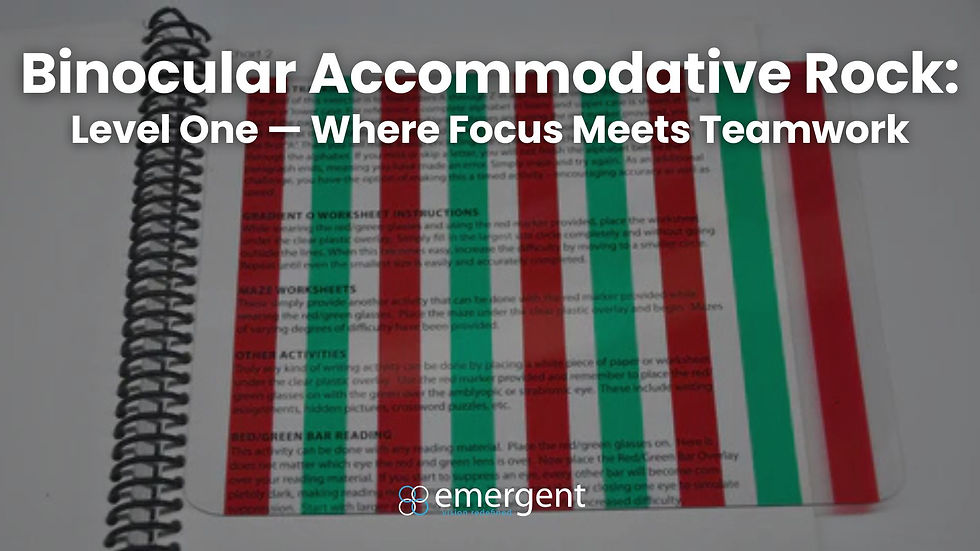
Binocular accommodative rock only works when both eyes are participating. That sounds obvious, but in practice, it’s surprisingly easy for suppression to sneak in unnoticed, especially in higher-functioning patients who are skilled compensators. This is why anti-suppression tools like red/green filters are essential, not optional.
When we introduce binocular accommodative rock with anti-suppression in place, the task changes immediately. The patient can no longer rely on one dominant eye to carry the load. Each accommodative shift must be accompanied by true binocular cooperation, and any imbalance becomes visible. Blur, diplopia, or visual discomfort are not failures. They are information.
The convergence-divergence relationship becomes especially clear under these conditions. Minus lenses increase accommodative demand and drive convergence; plus lenses require both systems to relax together. If convergence lags, minus becomes unstable. If divergence is weak, plus becomes effortful. Binocular accommodative rock exposes whether these systems are linked appropriately or fighting each other behind the scenes.
Working distance further challenges suppression patterns. A slight change in distance can tip a fragile binocular system into avoidance. A patient who maintains fusion at one distance may suppress the moment the accommodative demand increases, even subtly. Watching how quickly and how often suppression appears helps guide our pacing, lens choices, and target selection.
Ultimately, binocular accommodative rock with anti-suppression teaches the visual system that clarity and comfort require cooperation. It reinforces the idea that both eyes must show up, stay present, and adapt together, exactly what real-world vision demands.
Anti-suppression work demands equipment built for accuracy and durability.


Comments